Think Forward.

THE WAR OF THE WORLDS - BOOK ONE THE COMING OF THE MARTIANS - I. THE EVE OF THE WAR. [2/2] 5795

In spite of all that has happened since, I still remember that vigil very distinctly: the black and silent observatory, the shadowed lantern throwing a feeble glow upon the floor in the corner, the steady ticking of the clockwork of the telescope, the little slit in the roof—an oblong profundity with the stardust streaked across it. Ogilvy moved about, invisible but audible. Looking through the telescope, one saw a circle of deep blue and the little round planet swimming in the field. It seemed such a little thing, so bright and small and still, faintly marked with transverse stripes, and slightly flattened from the perfect round. But so little it was, so silvery warm—a pin’s head of light! It was as if it quivered, but really this was the telescope vibrating with the activity of the clockwork that kept the planet in view. As I watched, the planet seemed to grow larger and smaller and to advance and recede, but that was simply that my eye was tired. Forty millions of miles it was from us—more than forty millions of miles of void. Few people realise the immensity of vacancy in which the dust of the material universe swims. Near it in the field, I remember, were three faint points of light, three telescopic stars infinitely remote, and all around it was the unfathomable darkness of empty space. You know how that blackness looks on a frosty starlight night. In a telescope it seems far profounder. And invisible to me because it was so remote and small, flying swiftly and steadily towards me across that incredible distance, drawing nearer every minute by so many thousands of miles, came the Thing they were sending us, the Thing that was to bring so much struggle and calamity and death to the earth. I never dreamed of it then as I watched; no one on earth dreamed of that unerring missile. That night, too, there was another jetting out of gas from the distant planet. I saw it. A reddish flash at the edge, the slightest projection of the outline just as the chronometer struck midnight; and at that I told Ogilvy and he took my place. The night was warm and I was thirsty, and I went stretching my legs clumsily and feeling my way in the darkness, to the little table where the siphon stood, while Ogilvy exclaimed at the streamer of gas that came out towards us. That night another invisible missile started on its way to the earth from Mars, just a second or so under twenty-four hours after the first one. I remember how I sat on the table there in the blackness, with patches of green and crimson swimming before my eyes. I wished I had a light to smoke by, little suspecting the meaning of the minute gleam I had seen and all that it would presently bring me. Ogilvy watched till one, and then gave it up; and we lit the lantern and walked over to his house. Down below in the darkness were Ottershaw and Chertsey and all their hundreds of people, sleeping in peace. He was full of speculation that night about the condition of Mars, and scoffed at the vulgar idea of its having inhabitants who were signalling us. His idea was that meteorites might be falling in a heavy shower upon the planet, or that a huge volcanic explosion was in progress. He pointed out to me how unlikely it was that organic evolution had taken the same direction in the two adjacent planets. “The chances against anything manlike on Mars are a million to one,” he said. Hundreds of observers saw the flame that night and the night after about midnight, and again the night after; and so for ten nights, a flame each night. Why the shots ceased after the tenth no one on earth has attempted to explain. It may be the gases of the firing caused the Martians inconvenience. Dense clouds of smoke or dust, visible through a powerful telescope on earth as little grey, fluctuating patches, spread through the clearness of the planet’s atmosphere and obscured its more familiar features. Even the daily papers woke up to the disturbances at last, and popular notes appeared here, there, and everywhere concerning the volcanoes upon Mars. The seriocomic periodical Punch, I remember, made a happy use of it in the political cartoon. And, all unsuspected, those missiles the Martians had fired at us drew earthward, rushing now at a pace of many miles a second through the empty gulf of space, hour by hour and day by day, nearer and nearer. It seems to me now almost incredibly wonderful that, with that swift fate hanging over us, men could go about their petty concerns as they did. I remember how jubilant Markham was at securing a new photograph of the planet for the illustrated paper he edited in those days. People in these latter times scarcely realise the abundance and enterprise of our nineteenth-century papers. For my own part, I was much occupied in learning to ride the bicycle, and busy upon a series of papers discussing the probable developments of moral ideas as civilisation progressed. One night (the first missile then could scarcely have been 10,000,000 miles away) I went for a walk with my wife. It was starlight and I explained the Signs of the Zodiac to her, and pointed out Mars, a bright dot of light creeping zenithward, towards which so many telescopes were pointed. It was a warm night. Coming home, a party of excursionists from Chertsey or Isleworth passed us singing and playing music. There were lights in the upper windows of the houses as the people went to bed. From the railway station in the distance came the sound of shunting trains, ringing and rumbling, softened almost into melody by the distance. My wife pointed out to me the brightness of the red, green, and yellow signal lights hanging in a framework against the sky. It seemed so safe and tranquil.

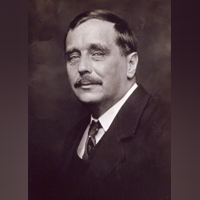
Bluwr X Commons: H. G. Wells Bluwr X Commons: H. G. Wells

Bluwr X Commons: H. G. Wells

Herbert George Wells (21 September 1866 – 13 August 1946) was a prolific English writer and futurist. He is mostly known for his science fiction novels, including the ‘The Time Machine’ and the 'The War of the Worlds'.


0

0

THE MEDITATIONS - Book I.[1/3] 5539

1. I learned from my grandfather, Verus, to use good manners, and to put restraint on anger. 2. In the famous memory of my father I had a pattern of modesty and manliness. 3. Of my mother I learned to be pious and generous; to keep myself not only from evil deeds, but even from evil thoughts; and to live with a simplicity which is far from customary among the rich. 4. I owe it to my great-grandfather that I did not attend public lectures and discussions, but had good and able teachers at home; and I owe him also the knowledge that for things of this nature a man should count no expense too great. 5. My tutor taught me not to favour either green or blue at the chariot races, nor, in the contests of gladiators, to be a supporter either of light or heavy armed. He taught me also to endure labour; not to need many things; to serve myself without troubling others; not to intermeddle in the affairs of others, and not easily to listen to slanders against them. 6. Of Diognetus I had the lesson not to busy myself about vain things; not to credit the great professions of such as pretend to work wonders, or of sorcerers about their charms, and their expelling of Demons and the like; not to keep quails (for fighting or divination), nor to run after such things; to suffer freedom of speech in others, and to apply myself heartily to philosophy. Him also I must thank for my hearing first Bacchius, then Tandasis and Marcianus; that I wrote dialogues in my youth, and took a liking to the philosopher’s pallet and skins, and to the other things which, by the Grecian discipline, belong to that profession. 7. To Rusticus I owe my first apprehensions that my nature needed reform and cure; and that I did not fall into the ambition of the common Sophists, either by composing speculative writings or by declaiming harangues of exhortation in public; further, that I never strove to be admired by ostentation of great patience in an ascetic life, or by display of activity and application; that I gave over the study of rhetoric, poetry, and the graces of language; and that I did not pace my house in my senatorial robes, or practise any similar affectation. I observed also the simplicity of style in his letters, particularly in that which he wrote to my mother from Sinuessa. I learned from him to be easily appeased, and to be readily reconciled with those who had displeased me or given cause of offence, so soon as they inclined to make their peace; to read with care; not to rest satisfied with a slight and superficial knowledge; nor quickly to assent to great talkers. I have him to thank that I met with the discourses of Epictetus, which he furnished me from his own library. 8. From Apollonius I learned true liberty, and tenacity of purpose; to regard nothing else, even in the smallest degree, but reason always; and always to remain unaltered in the agonies of pain, in the losses of children, or in long diseases. He afforded me a living example of how the same man can, upon occasion, be most yielding and most inflexible. He was patient in exposition; and, as might well be seen, esteemed his fine skill and ability in teaching others the principles of philosophy as the least of his endowments. It was from him that I learned how to receive from friends what are thought favours without seeming humbled by the giver or insensible to the gift. 9. Sextus was my pattern of a benign temper, and his family the model of a household governed by true paternal affection, and a steadfast purpose of living according to nature. Here I could learn to be grave without affectation, to observe sagaciously the several dispositions and inclinations of my friends, to tolerate the ignorant and those who follow current opinions without examination. His conversation showed how a man may accommodate himself to all men and to all companies; for though companionship with him was sweeter and more pleasing than any sort of flattery, yet he was at the same time highly respected and reverenced. No man was ever more happy than he in comprehending, finding out, and arranging in exact order the great maxims necessary for the conduct of life. His example taught me to suppress even the least appearance of anger or any other passion; but still, with all this perfect tranquillity, to possess the tenderest and most affectionate heart; to be apt to approve others yet without noise; to have much learning and little ostentation. 10. I learned from Alexander the Grammarian to avoid censuring others, to refrain from flouting them for a barbarism, solecism, or any false pronunciation. Rather was I dexterously to pronounce the words rightly in my answer, confining approval or objection to the matter itself, and avoiding discussion of the expression, or to use some other form of courteous suggestion. 11. Fronto made me sensible how much of envy, deceit and hypocrisy surrounds princes; and that generally those whom we account nobly born have somehow less natural affection. 12. I learned from Alexander the Platonist not often nor without great necessity to say, or write to any man in a letter, that I am not at leisure; nor thus, under pretext of urgent affairs, to make a practice of excusing myself from the duties which, according to our various ties, we owe to those with whom we live. 13. Of Catulus I learned not to condemn any friend’s expostulation even though it were unjust, but to try to recall him to his former disposition; to stint no praise in speaking of my masters, as is recounted of Domitius and Athenodorus; and to love my children with true affection. 14. Of Severus, my brother, I learned to love my kinsmen, to love truth, to love justice. Through him I came to know Thrasea, Helvidius, Cato, Dion, and Brutus. He gave me my first conception of a Commonwealth founded upon equitable laws and administered with equality of right; and of a Monarchy whose chief concern is the freedom of its subjects. Of him I learned likewise a constant and harmonious devotion to Philosophy; to be ready to do good, to be generous with all my heart. He taught me to be of good hope and trustful of the affection of my friends. I observed in him candour in declaring what he condemned in the conduct of others; and so frank and open was his behaviour, that his friends might easily see without the trouble of conjecture what he liked or disliked.