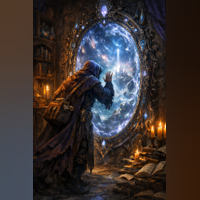

Aleister Crowley 6455
Aleister Crowley (1875–1947) was an English occultist, writer, mystic, and ceremonial magician who became one of the most influential and controversial figures in modern Western esotericism. Born Edward Alexander Crowley into a strict Christian family belonging to the Plymouth Brethren, he developed a strong desire to question traditional beliefs and explore alternative spiritual paths as a reaction to his rigid religious upbringing.
While studying at Trinity College, Cambridge, Crowley became interested in poetry, philosophy, and mystical traditions. Around this time, he began studying the occult and eventually joined the Hermetic Order of the Golden Dawn, an organization dedicated to ceremonial magic, Kabbalah, astrology, and spiritual symbolism. Although Crowley learned many magical techniques within the order, disagreements and personal conflicts with other members eventually led him to leave and pursue his own spiritual system.
One of the most important developments in Crowley’s life occurred in 1904, when he claimed to have received a spiritual revelation in Cairo, Egypt. According to Crowley, a being or intelligence called Aiwass dictated a text to him over three days. This text became known as The Book of the Law (Liber AL vel Legis) and formed the foundation of his spiritual philosophy, known as Thelema.
Crowley wrote numerous books explaining his philosophy and magical system. Some of his most important works include Magick in Theory and Practice, The Book of Thoth, and The Equinox—a series of publications in which he documented magical rituals, mystical experiences, and philosophical ideas.
Beyond his writings and magical practices, Crowley was also an avid traveler, mountaineer, and explorer of religious traditions from different cultures, including Eastern philosophy and yoga. He later became associated with the Ordo Templi Orientis (O.T.O.), an esoteric organization in which he eventually assumed a leadership role and integrated many of his Thelemic teachings. Central to Thelema is the famous principle “Do what thou wilt shall be the whole of the Law,” a statement often misunderstood as promoting unrestricted behavior but which Crowley interpreted as encouraging individuals to discover and fulfill their “True Will,” or authentic life purpose.
Although Crowley gained a reputation in the media as “The Wickedest Man in the World,” much of this reputation stemmed from sensationalist newspaper coverage, his own provocative self-promotion, and widespread misunderstandings of his ideas. Despite the controversy surrounding him, his influence on modern occultism, ceremonial magic, and alternative spirituality has been significant.
Today, Aleister Crowley is remembered as the founder of Thelema, and his ideas continue to influence modern ceremonial magic, esoteric organizations, contemporary occult traditions, and individuals interested in mysticism, spirituality, and self-exploration. His work has also influenced aspects of modern popular culture, including literature, music, and artistic movements connected to alternative spirituality and symbolism.