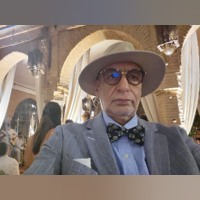
Mustapha Hadji, African Ballon d’Or: From the Silence of the Pastures to the Voice of the Stadiums...
5
Mustapha Hadji's record of achievements fits into a few lines, but each one carries immense weight in the history of African football, Moroccan youth, and especially for Mustapha himself.
African Ballon d’Or in 1998, key architect of Morocco's epic run at the World Cup in France, respected international, elegant playmaker, discreet ambassador for football and the youth of Morocco's pre-desert interior. Titles, distinctions, numbers. And yet, reducing Hadji to his record would miss the essence: a rare human journey, almost cinematic, that begins far from the spotlight.
For before the European pitches, before the anthems and trophies, there was a douar near Guelmim. A harsh, rugged region where childhood unfolds to the rhythm of the sun and the herds. The wind is dry and fierce. The horizon stretches endlessly. Children there gaze at the Atlas and the majesty of its summits at every moment. The soil is hard and rocky. Like many children his age, Mustapha became a shepherd as soon as he could walk, as soon as he could be independent. He quickly became the guardian of what his family and douar held most precious: goats and sheep. He learned patience, solitude, and observation early on. Qualities that would later make him a unique player, able to read the game before others, sense the ball, and adjust his movement.
The turning point came with family reunification. Destination: France. The shock was immense. Change of language, climate, social codes. At school, Mustapha struggled to fit in. He didn't understand everything, spoke little, often withdrawing into himself. But where words failed, the ball became his language.
It was on neighborhood fields that his talent began to shine. Instinctive, fluid football, almost poetic. No calculations, just the joy of playing, of finally expressing himself, of showing what he was capable of. Around him, kind eyes lingered. Coaches, educators, humanistic figures who saw beyond academic or linguistic struggles. And above all, there was a father who rose early to work and a mother who watched over them. A constant, demanding, protective presence. She guided, encouraged, reminded them of the importance of work and discipline. It was in her genes. She knew where she came from. Nothing was left to chance.
From there, the ascent became unstoppable. Club by club, Mustapha Hadji refined his game. He wasn't the strongest or the fastest, but he understood football. The ball adopted and loved him. He played between the lines, made others play, elevated the collective. His style stood out in an era dominated by physicality. He imposed a different grammar: that of intelligence and creativity.
1998 marked the pinnacle. The World Cup in France revealed Hadji to the wider public. Morocco captivated, impressed, came close to a feat. Hadji was its technical soul. Months later, the African Ballon d’Or crowned this singular trajectory. Continental recognition, but also a powerful symbol: a child of Guelmim becoming a reference in African football. Without ever denying his roots, he elevated them in his story. He always evokes them with nostalgia and gratitude.
After the heights, Mustapha Hadji didn't turn into a flashy icon. He remained true to a certain sobriety. That of the Moor descending from the man of Jbel Ighoud. Like his 40 million compatriots, he embodies 350,000 years of history, no scandals, few bombastic statements. Rare elegance, on and off the pitch. Later, he would pass on knowledge, support, advise, always with the same discretion.
Mustapha Hadji's story deserves more than a one-off tribute. It calls for a series, a long-form narrative. Because it speaks of exile and integration, transmission and merit, raw talent shaped by effort and human guidance. Above all, it reminds us that behind every trophy hides a child, often silent, who learned to turn fragility into strength.
In a modern football world sometimes afflicted by amnesia, Mustapha Hadji's path remains a lesson. A lesson in play, but above all a lesson in life.
During the 4th African Days of Investment and Employment, dedicated to football as a vector for socio-economic inclusion, held at the Faculty of Legal and Social Sciences - Souissi, in Rabat, Mustapha was invited to the stage by Dounia Siraj, the icon of sports journalism, another example of success from innovative, committed, confident youth. She masterfully directed a ceremony where she had to, among other things, give the floor to Fouzi Lakjaa and Midaoui. She did so without flinching, with a steady voice and dignified posture. Mustapha spoke and shared his story. The words were powerful, precise, and true. The posture was dignified. The audience was moved. The many young students listened in awe. They were living a unique moment. Rare inspiration. Mustapha, smiling, recounted. The words flowed in a breathtaking narrative.
That's when I spoke up to challenge Moroccan cinema. Doesn't this unique story, like so many others, deserve to be told in a film, in a series? Mustapha's words and expressions are so powerful that, translated into images, they could show all emerging youth the values of work, seriousness, self-confidence, and commitment.
The Marrakech Festival had just closed the day before. As Mustapha spoke, I dreamed of seeing a film about Mustapha Hadji win the Golden Star... at a future edition. Moroccan cinema should play that role too. That of perpetuating the Kingdom's youth successes. Cinema must tell us, and especially the youth, these great stories of achievement in countless fields—and God knows there are many.
Don't the stories of Nezha Bidouane, Hicham El Guerrouj, Said Aouita, Salah Hissou, Moulay Brahim Boutayeb, Abdelmajid Dolmy, Si Mohamed Timoumi or Achik, Nawal El Moutawakel deserve to be told in books, in films? Those of Jilali Gharbaoui, Mohamed Choukri, Abdelouhab Doukkali, Abdelhadi Belkhayat, Tayeb Seddiki, Tayeb Laalj, Fatna Bent Lhoucine, Fadoul, Miloud Chaabi, Haj Omar Tissir (Nesblssa), and many more—don't they deserve to be brought to the screen?
Thank you, Si Mustapha, for being a great player, a national pride, and above all for continuing to do what you do with brilliance: motivating and inspiring our youth, sharpening our national pride through this renewed education, the pillar of a sovereign Morocco that lifts its youth toward a prosperous and enlightened future.
Share:
Mustapha Hadji, African Ballon d’Or: From the Silence of the Pastures to the Voice of the Stadiums...
copy:
https://bluwr.com/p/584355577