Think Forward.

Hallucinations 1373

Hallucinations Quand vient la nuit j'appréhende le noir Je panique je deviens blême le soir Pourtant je ne crois pas toutes ses histoires Je récite des prières et ne fais que boire J'essaye d'oublier tous mes déboires Je déambule dans les lugubres couloirs Je transpire de partout dans le noir Soudain surgit de nulle part son fantôme qui croire.? Je ferme les yeux pour ne plus la voir Elle disparaît comme de son vivant sans me dire au revoir Dr Bouchareb Fouad Tous les droits sont réservés Rosny Sous Bois juin 2025
Boucharfou Boucharfou

Boucharfou

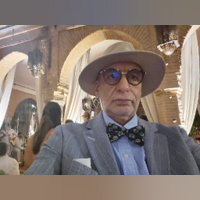
Le Dr Fouad Bouchareb est un médecin marocain ayant exercé pendant 35 ans dans le domaine de la santé publique. Originaire de Sefrou, il a travaillé dans plusieurs régions du Maroc, notamment Safi et Souss-Massa-Draa. Il est connu pour ses récits touchants sur ses expériences médicales, ses relations avec ses patients et les défis auxquels il a été confronté en tant que professionnel de la santé.


3200

0

The Radiance of a Lady 9

​Your love illuminates my heart, And you have forbidden me to reveal this honor. How can the light of your brilliance be dimmed When it radiates from everywhere? It shines like a sapphire, a diamond, or a jewel, And dazzles everyone with your blonde beauty. You do not believe in my love, In turn, While I can love no one else but you; This is my destiny, this is my faith. You are my heart and my soul, You are my destiny, you are my law. I cannot bear it when you are far away, beautiful woman, You who soothe my heart in flames. In you, I find all my vows, You who make my days happy. ​Dr. Fouad Bouchareb Inspired by an Andalusian music piece, "Bassit Ibahane" December 13, 2025 https://youtu.be/wlvhOVGyLek?si=5tt6cm0oChF1NQJJ

Mustapha Hadji, African Ballon d’Or: From the Silence of the Pastures to the Voice of the Stadiums... 64

Mustapha Hadji's record of achievements fits into a few lines, but each one carries immense weight in the history of African football, Moroccan youth, and especially for Mustapha himself. African Ballon d’Or in 1998, key architect of Morocco's epic run at the World Cup in France, respected international, elegant playmaker, discreet ambassador for football and the youth of Morocco's pre-desert interior. Titles, distinctions, numbers. And yet, reducing Hadji to his record would miss the essence: a rare human journey, almost cinematic, that begins far from the spotlight. For before the European pitches, before the anthems and trophies, there was a douar near Guelmim. A harsh, rugged region where childhood unfolds to the rhythm of the sun and the herds. The wind is dry and fierce. The horizon stretches endlessly. Children there gaze at the Atlas and the majesty of its summits at every moment. The soil is hard and rocky. Like many children his age, Mustapha became a shepherd as soon as he could walk, as soon as he could be independent. He quickly became the guardian of what his family and douar held most precious: goats and sheep. He learned patience, solitude, and observation early on. Qualities that would later make him a unique player, able to read the game before others, sense the ball, and adjust his movement. The turning point came with family reunification. Destination: France. The shock was immense. Change of language, climate, social codes. At school, Mustapha struggled to fit in. He didn't understand everything, spoke little, often withdrawing into himself. But where words failed, the ball became his language. It was on neighborhood fields that his talent began to shine. Instinctive, fluid football, almost poetic. No calculations, just the joy of playing, of finally expressing himself, of showing what he was capable of. Around him, kind eyes lingered. Coaches, educators, humanistic figures who saw beyond academic or linguistic struggles. And above all, there was a father who rose early to work and a mother who watched over them. A constant, demanding, protective presence. She guided, encouraged, reminded them of the importance of work and discipline. It was in her genes. She knew where she came from. Nothing was left to chance. From there, the ascent became unstoppable. Club by club, Mustapha Hadji refined his game. He wasn't the strongest or the fastest, but he understood football. The ball adopted and loved him. He played between the lines, made others play, elevated the collective. His style stood out in an era dominated by physicality. He imposed a different grammar: that of intelligence and creativity. 1998 marked the pinnacle. The World Cup in France revealed Hadji to the wider public. Morocco captivated, impressed, came close to a feat. Hadji was its technical soul. Months later, the African Ballon d’Or crowned this singular trajectory. Continental recognition, but also a powerful symbol: a child of Guelmim becoming a reference in African football. Without ever denying his roots, he elevated them in his story. He always evokes them with nostalgia and gratitude. After the heights, Mustapha Hadji didn't turn into a flashy icon. He remained true to a certain sobriety. That of the Moor descending from the man of Jbel Ighoud. Like his 40 million compatriots, he embodies 350,000 years of history, no scandals, few bombastic statements. Rare elegance, on and off the pitch. Later, he would pass on knowledge, support, advise, always with the same discretion. Mustapha Hadji's story deserves more than a one-off tribute. It calls for a series, a long-form narrative. Because it speaks of exile and integration, transmission and merit, raw talent shaped by effort and human guidance. Above all, it reminds us that behind every trophy hides a child, often silent, who learned to turn fragility into strength. In a modern football world sometimes afflicted by amnesia, Mustapha Hadji's path remains a lesson. A lesson in play, but above all a lesson in life. During the 4th African Days of Investment and Employment, dedicated to football as a vector for socio-economic inclusion, held at the Faculty of Legal and Social Sciences - Souissi, in Rabat, Mustapha was invited to the stage by Dounia Siraj, the icon of sports journalism, another example of success from innovative, committed, confident youth. She masterfully directed a ceremony where she had to, among other things, give the floor to Fouzi Lakjaa and Midaoui. She did so without flinching, with a steady voice and dignified posture. Mustapha spoke and shared his story. The words were powerful, precise, and true. The posture was dignified. The audience was moved. The many young students listened in awe. They were living a unique moment. Rare inspiration. Mustapha, smiling, recounted. The words flowed in a breathtaking narrative. That's when I spoke up to challenge Moroccan cinema. Doesn't this unique story, like so many others, deserve to be told in a film, in a series? Mustapha's words and expressions are so powerful that, translated into images, they could show all emerging youth the values of work, seriousness, self-confidence, and commitment. The Marrakech Festival had just closed the day before. As Mustapha spoke, I dreamed of seeing a film about Mustapha Hadji win the Golden Star... at a future edition. Moroccan cinema should play that role too. That of perpetuating the Kingdom's youth successes. Cinema must tell us, and especially the youth, these great stories of achievement in countless fields—and God knows there are many. Don't the stories of Nezha Bidouane, Hicham El Guerrouj, Said Aouita, Salah Hissou, Moulay Brahim Boutayeb, Abdelmajid Dolmy, Si Mohamed Timoumi or Achik, Nawal El Moutawakel deserve to be told in books, in films? Those of Jilali Gharbaoui, Mohamed Choukri, Abdelouhab Doukkali, Abdelhadi Belkhayat, Tayeb Seddiki, Tayeb Laalj, Fatna Bent Lhoucine, Fadoul, Miloud Chaabi, Haj Omar Tissir (Nesblssa), and many more—don't they deserve to be brought to the screen? Thank you, Si Mustapha, for being a great player, a national pride, and above all for continuing to do what you do with brilliance: motivating and inspiring our youth, sharpening our national pride through this renewed education, the pillar of a sovereign Morocco that lifts its youth toward a prosperous and enlightened future.

Law 30-09 on Physical Education and Sports in Morocco: An Obsolete Brake on Sport Development... 101

Promulgated in 2010, Law 30-09 aimed to modernize Moroccan sports governance, regulate the associative movement, and pave the way for professionalization. Fourteen years later, its record is mixed: while it established a formal structure, it has always been said that it fails to meet the demands of modern sports and lacks incentives and encouragement. Today, it is accused of being a **structural brake** on Moroccan sports due to its rigid, ill-adapted, and partially unconstitutional framework. Worse still, launched well before the royal letter to the sports assemblies of 2008, the project underwent no adjustments to align with royal directives. The authors likely believed it sufficiently addressed the letter's content and saw no need to withdraw it. The questioning, already sharp since its promulgation, has intensified in light of the 2011 Constitution, which elevates physical activity to a citizen's right and requires the State to promote high-level sports while fostering associative participation. The approach of the 2030 World Cup, moreover, demands urgent legislative adaptation. During the 4th edition of the African Days of Investment and Employment, dedicated to football as a vector for socio-economic inclusion and organized by the Faculty of Legal, Economic, and Social Sciences-Souissi in Rabat, the president of the Royal Moroccan Football Federation, Fouzi Lekjaa, stated bluntly that Law 30-09 had run its course and that a new version was needed to support the country's sporting development. The main issues first stem from a **discordance with the 2011 Constitution**. Designed before this fundamental revision, Law 30-09 does not explicitly guarantee the right to sports as a citizen's right. It limits associative freedom through a discretionary approval regime, contradicting the constitutional principle of freedom of association enshrined in the 1958 Public Freedoms Code, which remains in force. Similarly, it assigns the State a vague role in regulation and funding, undermining federations' autonomy and exposing them to administrative paralysis. It is also clear that there is **ambiguity in the status of professional athletes**. Despite constitutional recognition of the right to work and social protection, the law defines neither a clear sports contract nor specific protections. This legal vacuum fuels recurrent conflicts between clubs, players, and federations. A **disconnect with modern sports** is also evident. Tied to a bureaucratic and centralized vision, the law ignores international standards and performance- or objective-based governance mechanisms. Professionalization remains incomplete: clubs lack stable legal structures, economic models are precarious, and private investors are discouraged. The role of local authorities remains unclear, despite advanced regionalization, making sports investments dependent on local wills rather than a coherent national framework. The law's rigidity hampers rapid contracting, flexibility for infrastructure, and federations' independence. It generates administrative delays for public-private partnerships, the absence of status for sports companies, and difficulties integrating international norms, thus blocking attractiveness for private capital. One can thus suspect its **incompatibility with FIFA requirements and the 2030 World Cup**. Criticism extends to the education sector with a certain **inadequacy with educational reform**. While Morocco invests in school and university sports, the law omits any systemic integration between schools, universities, clubs, and federations, as well as pathways between mass and elite sports. The law unduly mixes amateur and professional sports, without distinguishing associative management from clubs' commercial activities. Another weakness lies in the definition of concepts and thus the clear assignment of resulting responsibilities. It subjects the associative fabric, the pillar of the sports movement, to excessive oversight, creating legal insecurity and constant workarounds. Finally, it conceives sports as an educational or cultural activity, ignoring its economic potential: sports jobs, sponsorship, broadcasting rights, specific taxation, and job creation. Conceived in a pre-constitutional context, Law 30-09 is today **obsolete, rigid, and partially unconstitutional**. It hinders governance, professionalization, and the sports economy at a time when Morocco is projecting itself toward major global events. The situation thus leads to the need for a new law: modern, aligned with the Constitution, the intent of the 2008 royal letter, the demands of modern sports in line with international bodies, and responsive to the imperatives for the 2030 World Cup, while inventing a new mode of management and administration detached from political timelines. A mission-oriented administration is widely desired. The new law must align with the constitutional framework by clearly defining concepts, enshrining sports as a citizen's right, protecting associative freedom, and clarifying the State's role (framing, funding, audits, performance contracts). It should distinguish between amateur and professional sports, between clubs and associations, and establish full professionalization: professional athlete status, mandatory sports companies for clubs, regulation of private investments. It must enable sports integration into the national economy via a dedicated tax framework, specific investment code, sectoral recognition, and modernization of sponsorship and TV rights. It must harmonize with FIFA 2030 requirements through greater flexibility, regulate infrastructure, and secure major projects. The new law should define the State's responsibilities in training frameworks and required levels, making academic training the foundation of a national system capable of meeting practice demands and society's true needs. It must also specify the role and responsibilities of regions and local authorities in mass sports, proximity infrastructure creation, and supervision—a sort of municipalization of mass physical activities. This long-awaited new law is **urgent, strategic, and essential** to align Moroccan sports with international standards and national ambitions.

The Radiance of a Lady 146

​Your love illuminates my heart, And you have forbidden me to reveal this honor. How can the light of your brilliance be dimmed When it radiates from everywhere? It shines like a sapphire, a diamond, or a jewel, And dazzles everyone with your blonde beauty. You do not believe in my love, In turn, While I can love no one else but you; This is my destiny, this is my faith. You are my heart and my soul, You are my destiny, you are my law. I cannot bear it when you are far away, beautiful woman, You who soothe my heart in flames. In you, I find all my vows, You who make my days happy. ​Dr. Fouad Bouchareb Inspired by an Andalusian music piece, "Bassit Ibahane" December 13, 2025 https://youtu.be/wlvhOVGyLek?si=5tt6cm0oChF1NQJJ